Project Overview
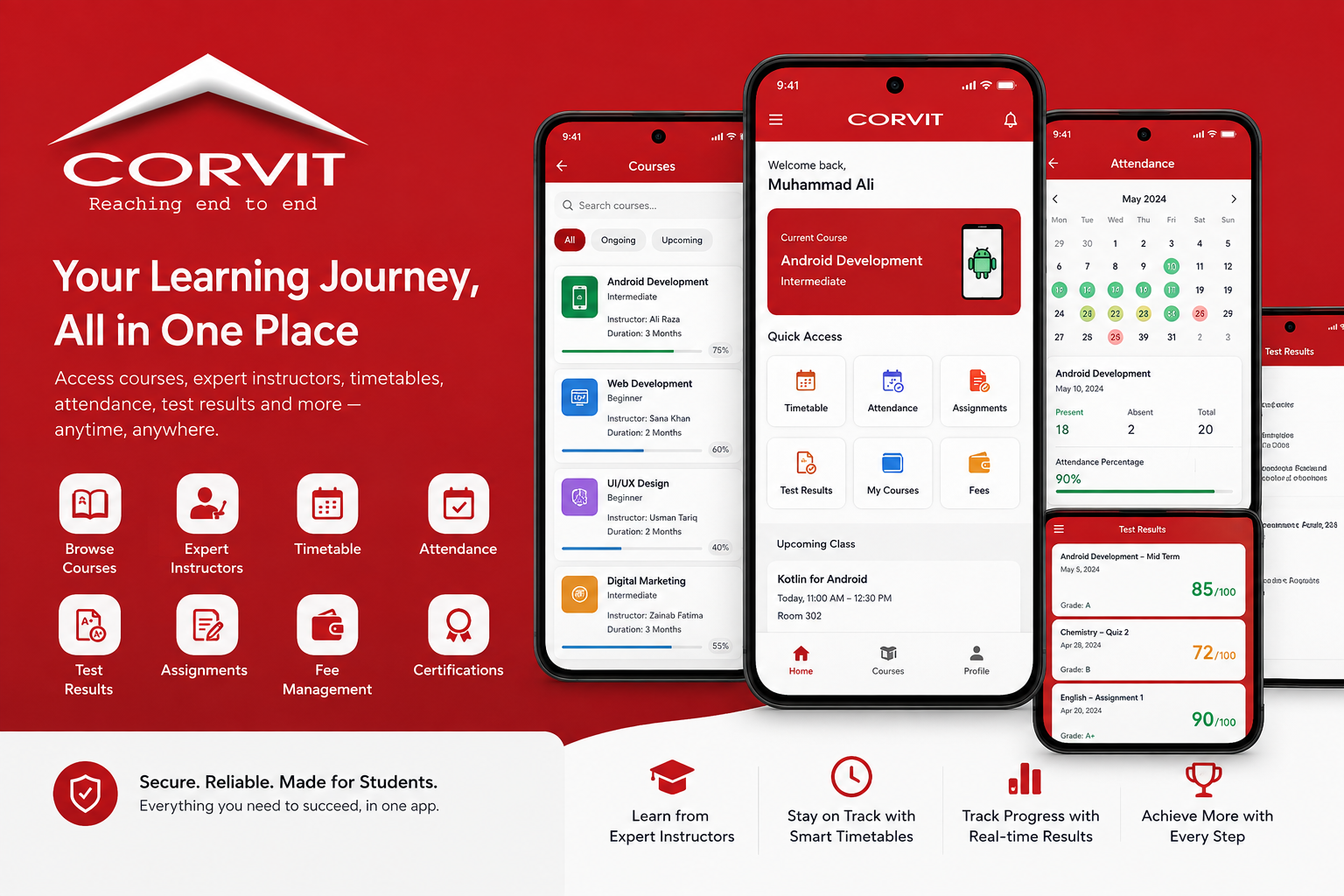
CORVIT ran its entire student and faculty workflow on paper — enrollment, attendance, assignments, fees, and results all handled manually, with no central system behind any of it. While working at StelleCloud, I built Corvit LMS solo, end to end: a production Android app that brings course browsing, enrollment, attendance, assignments, fee management, certifications, results, and in-app video lessons into one platform.
At a Glance
- ▹Business goal: Replace CORVIT's entirely manual, paper-based student and faculty processes with a single digital platform
- ▹Primary users: CORVIT students and faculty
- ▹Core solution: An end-to-end Android LMS covering enrollment, attendance, assignments, fees, results, and native video learning
- ▹Key outcome: A complete, production-grade application covering the full academic lifecycle, delivered to the client
Client or Business Context
CORVIT runs structured courses in batches, with its own attendance tracking, assignments, exams, certifications, and fee collection. Before this project, none of that ran through a digital system — every part of the student and faculty workflow was manual and paper-based.
I built Corvit LMS while working at StelleCloud, delivering it as a client engagement for CORVIT.
Project Positioning
This was a commissioned client project. CORVIT needed to move a fully manual, paper-based academic operation onto a single platform that both students and faculty could use directly, rather than continuing to rely on staff and paperwork for day-to-day processes.
The Challenge or Opportunity
What Was Not Working
- ▹Enrollment, attendance, assignments, fees, and results were all tracked manually, with no central digital record
- ▹Students had no self-service way to check attendance, assignment status, results, exam schedules, or fee balances
- ▹Course video content lived outside any unified system, with no in-app way to access it
- ▹Faculty and administration had no consolidated digital view of student activity across the institute
Why It Mattered
A fully manual process means every basic interaction — checking a fee balance, confirming an exam date, submitting an assignment — depends on staff availability and paperwork. That creates unnecessary friction for students and faculty alike, and leaves the institute without a digital record of its own operations to work from.
Project Goals
- ▹Digitize the full student lifecycle in one platform, from course browsing through to results
- ▹Give students self-service access to attendance, assignments, timetables, results, and fee status
- ▹Bring video learning content directly into the app, rather than routing students elsewhere
- ▹Deliver a secure, production-grade app built on modern Android architecture
The Approach
1. Understanding the Problem
Because CORVIT's process was entirely manual, there was no existing digital system to extend or migrate — the starting point was mapping the full student and faculty lifecycle, from browsing available courses through to receiving results and certificates, and identifying which parts most needed to move to self-service first.
2. Defining the Right Scope
Key scope decisions:
- ▹One centralized dashboard instead of separate tools: courses, attendance, assignments, certifications, results, and timetable all live under a single hub rather than as disconnected flows
- ▹A hybrid backend split by data type: Firebase Authentication and Firestore handle identity and real-time data, while a dedicated REST API (via Retrofit2) serves institute-specific academic data like courses, batches, attendance, and fees
- ▹Native video playback instead of linking out: course videos stream inside the app through an embedded YouTube player, so students aren't pulled into a separate app mid-lesson
3. Designing the Solution
Core solution components:
- ▹Authentication: Firebase Authentication with Google Sign-in, so students and faculty can get into the app with minimal friction
- ▹Course Catalog: courses, curriculum details, and available batches fetched dynamically via REST APIs
- ▹User Dashboard: a single hub for active enrollments, attendance and track record, assignments, certifications, term results and exam schedules, and the weekly timetable
- ▹Fee Management: digital challan generation, pending dues, and payment tracking, replacing manual fee collection records
- ▹Video Learning: an integrated YouTube player for streaming course resources natively, without switching apps
4. Building and Validating
The app was built entirely in Kotlin on Jetpack Compose, with an MVVM architecture and a dedicated MainNavGraph handling all Compose navigation. Retrofit2 and Coroutines manage the REST API layer, Firebase Firestore handles NoSQL data sync, Coil-kt handles image loading, and AndroidX DataStore manages local state and settings. The finished application was delivered to CORVIT as a production-ready build.
5. Solving the Hardest Problem
Challenge: Combining two backend sources into one coherent student experience
Why it was difficult: The app needed identity and some real-time data from Firebase Authentication and Firestore, while course, batch, attendance, and fee data came from a separate REST API built for the institute. Both had to feed into the same dashboard without the app feeling like two systems stitched together.
Decision made: I structured the data and view-model layers so each screen consumes a single, consistent state regardless of which backend it was sourced from — Firebase for identity and sync, Retrofit-based REST calls for academic records — keeping the split invisible to the user.
Outcome: Students and faculty interact with one dashboard and one consistent experience, even though the underlying data comes from two different sources.
The Solution
Corvit LMS gives CORVIT students and faculty a single Android app for the entire academic lifecycle. Students log in with Firebase-backed authentication (including Google Sign-in), browse and enroll in courses, and manage everything from attendance to fee payments and certifications from one dashboard — including watching course videos without leaving the app.
Key Capabilities
- ▹Unified student dashboard: active enrollments, attendance, assignments, certifications, results, exam schedules, and timetable all in one place
- ▹Digital fee management: challan generation, pending dues, and payment tracking, replacing manual fee records
- ▹In-app video learning: a native YouTube player for course resources, keeping students inside the app during lessons
- ▹Real-time notifications: alerts for students, built on Firebase
- ▹Light and dark theme support: built-in dynamic theming across the whole app
Key Results
Corvit LMS was built and handed over to the client as a production-grade release. No post-handover usage data is currently available, so the results below focus on what was delivered and the workflow it replaced rather than measured adoption.
Product and User Outcomes
- ▹Delivered a single Android app covering CORVIT's full student and faculty lifecycle — enrollment, attendance, assignments, fees, certifications, results, and timetable — replacing processes that had previously been entirely manual and paper-based
- ▹Gave students self-service access to attendance records, assignment status, results, exam schedules, and fee balances, rather than needing to go through staff for that information
- ▹Brought course video content into the app itself through native YouTube integration, removing the need to leave the app to watch lecture material
Technical Outcomes
- ▹Architecture: built entirely in Kotlin and Jetpack Compose on an MVVM structure, with a dedicated Compose navigation graph for the full application
- ▹Integration: combined Firebase Authentication and Firestore with a REST API layer (Retrofit2 and Coroutines) into one consistent data flow
- ▹Local persistence: AndroidX DataStore for local state and settings, Coil-kt for efficient image loading
- ▹Delivery: a complete, production-grade build handed over to the client
Qualitative Results
- ▹Replaced a fully manual, paper-based workflow spanning enrollment, attendance, assignments, fees, and results with a single digital platform
- ▹Consolidated five previously separate processes into one student and faculty dashboard
- ▹Delivered end to end, solo, as a client engagement through StelleCloud
Impact
Moving CORVIT from an entirely paper-based process to a single digital platform is a foundational shift for an institute operating at this scale. Enrollment, attendance, assignments, and fees no longer have to depend on manual paperwork and staff availability for every interaction — and results, schedules, and dues become things students can check themselves, whenever they need to.
Bringing video learning directly into the same app removes another point of friction: students no longer need to leave the platform, or the institute's own ecosystem, to access course material.
Technologies and Skills Demonstrated
Technology Stack
- ▹Frontend: Kotlin, Jetpack Compose, Material 3
- ▹Architecture: MVVM, Compose Navigation (
MainNavGraph) - ▹Network: Retrofit2, Kotlin Coroutines
- ▹Backend / BaaS: Firebase Authentication (with Google Sign-in), Firebase Firestore
- ▹Media: Native Android YouTube Player integration
- ▹Other: Coil-kt for image loading, AndroidX DataStore for local state and settings
Skills Demonstrated
- ▹End-to-end enterprise Android application architecture
- ▹Multi-source backend integration (Firebase alongside a custom REST API)
- ▹Secure authentication flows, including third-party sign-in
- ▹Domain modeling across a full institutional workflow — enrollment, attendance, fees, exams, certifications
- ▹Native third-party media integration
- ▹Solo delivery of a client project within an agency engagement
My Role and Contribution
I built Corvit LMS independently while working at StelleCloud, with CORVIT as the end client. The entire application — architecture, UI, integrations, and delivery — was my responsibility from start to finish.
I was responsible for:
- ▹The full application architecture and MVVM implementation, including the Compose navigation graph
- ▹All Jetpack Compose UI across the app — authentication, course catalog, dashboard, fee management, timetable, and settings
- ▹Integrating Firebase Authentication and Firestore alongside a REST API layer (Retrofit2 and Coroutines) for course, attendance, assignment, and fee data
- ▹Native YouTube Player integration for in-app video learning
- ▹Building and delivering the completed application to the client
Team setup: Solo developer, delivered as a client engagement through StelleCloud.
Lessons and Reflection
- ▹What worked well: Structuring the entire academic lifecycle around one central dashboard, rather than separate tools per function, kept a wide-scope app coherent for users encountering a digital system for the first time.
- ▹What I would improve: With no usage tracking in place after handover, I'd build in lightweight analytics or feedback capture for the next version, so real adoption and pain points can be measured rather than assumed.
- ▹What the project taught me: Digitizing a fully manual process means there's no existing system to migrate from — the scope decisions about what belongs in one dashboard versus a separate flow end up defining how usable the whole app feels from day one.
Closing Summary
Corvit LMS replaced CORVIT's fully manual, paper-based student and faculty processes with a single production Android app, covering enrollment, attendance, assignments, fees, certifications, results, and native video learning. Built solo, end to end, while working at StelleCloud, the app combines Firebase and a custom REST API into one coherent MVVM-based system, and was delivered to CORVIT as a complete, production-ready release.
Project takeaway: Delivered a full enterprise-scale LMS independently, turning an entirely manual institutional workflow into one coherent digital platform.
Optional Visuals
Screenshots of the login, dashboard, course catalog, attendance tracker, fee/challan screens, and timetable would strengthen this case study once available — add each with a short caption explaining what it shows and which part of the old manual process it replaces.